Greekgeek's Online Odyssey - Hubpages and Online Article Writing Tips

google

Hubpages, Squidoo, and Panda 2.2

I was just checking to see how Hubpages and Squidoo are doing, following the latest tweak Panda algorithm, 2.2, which I reported on back in June. Unfortunately, Hubpages’ traffic data has disappeared from Quantcast. [Update: It’s back. Phew.]

Panda 2.2 rolled out back on June 21st. By now we’ve had enough traffic data that we should begin to see a bit of a before-and-after change from that. To my surprise, Hubpages has stopped letting Quantcast report its numbers. I would’ve expected a slight uptick from Panda 2.2, which may be the first chance Hubpages would’ve had to get back in Google’s good graces after spam stomping. ( Panda is a special calculation done separately from ranking individual pages; it’s ranking a whole domain, and that number is then applied as a boost or penalty to pages posted on the domain, like an extra ranking factor. Since the Panda calculation is only performed again when someone at Google manually punches a button, a domain has to wait to be reassessed).

So anyway. Hubpages has followed Mahalo’s lead in hiding its data. A pity.

[UPDATE Aug 13: Hupbages is back on Quantcast! And I see a slight uptick after Panda 2.2. Pardon me for mentioning Mahalo and Hubpages in the same sentence; Hubpages tries to highlight quality content and stamp out spam, even if it sometimes has to mop up the mess created by unscrupulous people taking advantage of its free publishing platform. ]

So how’s Squidoo holding up? I wish I could get a detailed breakdown of past years versus this year, since there’s always a summertime drop. But here’s the 3 year overview:

And here’s the past 3 months.

Not much to tell us, but from what I can see, no drastic change from Panda 2.2.

Just as another interesting comparison, here’s Suite101.com vs. Squidoo for the past six months:

Owie. Again, so far so good for the Squid, but not so happy for Suite 101, an old web 1.0 site that’s got lots of good amidst the bad, from what I remember. (It probably depends on the neighborhood.)

Stay tuned for the next Panda Punch.


I realize some of the upheaval at Squidoo right now is, once again, Squidoo’s attempt to be prepared for the next round. I think the newest layer of spam filters need some fine-tuning, and I’m anxious about the process for dealing with false positives, but I understand the need for even more aggressive spam/scraper filters.
Google Adsense on Squidoo Lenses

Are your Google ads on Squidoo wildly inappropriate? Well, that sucks.

It would be worse on your own website, where clickthroughs directly impact earnings. On Squidoo, poorly-targeted ads don’t impact you quite so directly, since you’re not getting paid for individual clicks. (Otherwise people might game the system.) Instead, all Adsense revenue for Squidoo lenses gets put in the monthly Ad Pool — which also includes other advertising — and then distributed to the 85,000 top performing lenses via payout tiers.

However, there are three reasons poorly-targeted ads on Squidoo still matter to Jane Q. Lensmaster.

  • Highly inappropriate ads may turn off readers. “I’m an abuse survivor looking for tips on how to escape a stalking ex, and the ads are for people who want to hire private detectives to snoop on their spouses. UGH!”
  • Clickouts. You want clickouts, don’t you?
  • Indirectly, of course, we all benefit from more effectively targeted ads.

So, er, how does Google pick the ads for Adsense anyway? Well, as usual, I was tinkering around under the hood of a Squidoo lens, and I think I may have found the answer:

<!-- adsense setup -->
<script>
[... blah blah blah ...]
GA_googleAddAttr("cont_tag", "computer history,brief history of the internet,cern,computer history,history of web,internet history,internet map,internet timeline,tim bernerslee,web,who invented the internet,who invented the web,world wide web,www");
[... blah blah blah ...]
</script><!-- /adsense setup -->

See that “cont_tag” stuff? That’s the Squidoo tags for that lens. Assuming I’m understanding the code correctly, Google is using Squidoo tags to help it pick the ads on the page, as opposed to simply analyzing the page and deciding for itself what your page is about, as it does for search. (Alternatively, Adsense may be analyzing the text on your page and combining that data with what your keywords are to pick its ads.)

If you were really trying to maximize every click, you might want to poke around in Google’s Keywords Tool to find strong related keywords that advertisers are bidding for (that’s the competition) and that lots of people are searching for. That tool is what many of us use for SEO, but was actually designed to help you find and choose keywords for Google Adsense.

However, we’ve got other stuff to worry about besides optimizing our pages for Google ads. So it’s not worth your time to do it on Squidoo… unless you’re getting wildly inappropriate Adsense ads. In that case, it might be worth trying Google’s keywords tool to find alternative keyword phrases whose related searches seem to be more in line with what your page is about.

Unfortunately, not all ads on Squidoo lenses are Adsense: a significant number are Chitika, and they’re the ones that tend to be off-base. I see a bit of code that may imply the keyword tags are used by Chitika. But on the other hand, Chitika ads are often based on what people have searched to find your page, or on local advertisers in your reader’s neck of the woods. So the Chitika advertising on a Squidoo lens may not have much to do with your topic, but at least, hopefully, they have something to do with your reader.

Since the dawn of the web, I’ve learned most of what I know about HTML, CSS, and webpage design by checking under the hood with “View Source” (or, alternatively, through my shareware web page editor…MacOSX only, sorry) found under the “view” menu of most web browsers. I’ve discovered a lot of things about Squidoo this way. I don’t understand everything I see, but it’s fun detective work.


SEO Mojo: How’d He DO That?

Here’s another riddle.

Google “Greatest SEO” if you don’t mind somewhat strong language from a crass but knowledgeable SEO guy.
1. How’d he do that?

(Highlight for answer: Meta Description tag, which on Squidoo is supplied by the Introduction module.)

2. It’s ugly as Trump’s toupee, but it’s effective search engine optimization. It’s a tacky version of my mantra, “Make search results sexy.” It stands out in a page of search results, it’s liable to attract clicks, and, very importantly, it demonstrates that the website excels at what it promises: SEO.

So what can we learn from this? There are ways to do extremely powerful SEO that don’t involve backlinks or promoting your site. They don’t even involve keywords. They involve catching the customer’s attention, proving you have and know something they’re looking for, and then following through by delivering the promised content when they reach your page.

Simple Tip: Copying Google Search Links

I was a total idiot recently, wondering why my dashboard comments pane looked weird, until Fluff pointed out there was a long URL in it. (If I’d just taken care of the comment instead of sticking it on my To Do list, this would not have been a problem)!

But it illustrates an annoying problem about Google search results. Long ago, when you searched for something on Google, the Google search result page gave you the actual link of each search result. Nowadays, it throws a bunch of invisible gobbledygook into the link.

For example, if you search for “Nessie Heinrich Harder” (the name of an artist who did a painting of Nessie), you get:


The Loch Ness Monster: Nessie

www.proof-of-evolution.com/loch-ness-monster.htmlCached

Is Nessie, the Loch Ness Monster, really a plesiosaur trapped in a giant  A plesiosaur drawn by Heinrich Harder in 1916. The weight and anatomy of a 


Well, there we go. Want to share that link? You’d think you’d just right-click the clickable link, right? The part that’s underlined.

WRONG! If you do that, the URL copied to your clipboard is a monster:
http://www.google.com/url?sa=t&source=web&cd=1&ved=0CBgQFjAA&url=http%3A%2F%2Fwww.proof-of-evolution.com%2Floch-ness-monster.html&ei=sEojTsnVKMrc0QG45cnEAw&usg=AFQjCNHQAvPvGAL91lnFlD5fWh06KB21Dw

Ugh. Google, why? Okay, yes, I know why. You want to track every use of Google, and possible getting people to go to Google, not bypass you. But tough. I don’t wanna share that huge long link! I want the URL!

One could copy and paste the link written out under the page title:

www.proof-of-evolution.com/loch-ness-monster.html

But on Google’s listing it (a) isn’t a link, so you can’t right-click it to grab it and (b) is missing http:// at the beginning.

So, either you have to put the http:// back in, or you click on the link, GO to the webpage, and grab its real URL from this location bar. This is a good idea in case there’s a redirect. Also, you should probably not share a link without checking the page yourself  to make sure it’s kosher. You never know when a page will have a horribly annoying popup or other problem your readers may not appreciate.

Important Google News: Panda 2.2, rel=author, analytics

WOW. LOTS of Google news to report to Squidoo users this week: it’s piling up faster than I can digest it. Let me start with the most recent, since it’s the easiest to tell, though it will take you more time to use:

Squidoo Has Added Google Analytics

Finally. If you have Google Analytics, go to your profile right now and edit it to add your tracking number. If you haven’t a clue what Google Analytics and Squidoo is about, see How to Track Lenses With Google Analytics by theFluffanutta. Also see SquidHQ’s official announcement: What Is the Advantage of Using Google Analytics Over regular Squidoo stats?

But wait! Don’t go yet! There is more Google news for Squids.

Google Panda Update News

SMX (Search Marketing Expo) is the big online search convention where all the experts line up to catch pearls of wisdom from Google Spokespundit Matt Cutts. (There’s even a term for his groupies, Cuttlets. Lordie.) A rough transcript of webexpert Danny Sullivan’s interview with Matt Cutts is posted on Searchengineland. Takeaway lessons:

  • Google Panda is an algorithm run less frequently than Google’s daily indexing. Panda re-evaluates sites occasionally for spamminess, content quality, etc, and then the regular Google algorithm uses Panda’s site ranking to boost/lower pages found on that site.
  • Google Panda has yet to be implemented on non-English-based Google (Google has a different search engine gateway and database in each country, so for example, search results by someone using Google in France do not match the search results for someone using Google in England).
  • Expect a Panda 2.2 soon.  No word on what it will entail.
  • ALSO, the “web spam team” is implementing a tweak to cut down on scraped content outranking the original. Huzzah.

Google Pushes Rel=Author Tag

Also from the Matt Cutts interview: Google has implemented two new voluntary tags, rel=author and rel=me, which allow you to link to an author profile page you’ve set up and back.

I was fussing with this post for several days because I’m still not 100% whether to implement the rel=author tag based on this news. But let me try to explain what it means and why it matters, and then you can ponder along with me!

10-word summary: Using rel=author might boost traffic for some sites. Maybe.

[[UPDATE: See Giltotherescue’s comments below. Based on what he says, I suggest you skip this discussion unless you’re interested. I do NOT advise using rel=author on Squidoo at this time.]]

But if you’re curious…

(more…)

Tweeting = Submitting URL to Google?

An SEOmoz member reports on a few studies that seem to confirm what I suspected: search engines are using Tweeted links to find and index content, so Tweeting is essentially the modern equivalent of submitting a URL to a search engine. I have noticed this myself: lately when I Tweet a URL, it’s indexed pretty much instantaneously on Google. (Case in point: I Tweeted my last post, and it was on Google by the time I switched to Google and searched for its title.)  In fact I’m NOT going to Tweet this post, and see how long it takes to be indexed, so please don’t spoil the experiment by Tweeting it. I’ll update later today what the result is.

Note that Bing isn’t that quick. That post has not yet been picked up by Bing. (Also, disturbingly, I see Bing is ranking scraped content from my Hubpages vs. Squidoo Panda Update lens on page one, whereas the actual article is nowhere to be found. Not impressed, Bing.)

According to the article I linked to above, there’s some evidence that Tweets from Twitter members with established, respected reputations may be a minor Google ranking factor. That is, in addition to helping Google find new posts and content, Tweets from respected figures may actually boost the links Tweeted in Google’s search engine results. I haven’t seen enough data on this to call this confirmed, but it makes sense.

Of course, most of us don’t have that kind of authority, so we should be using Twitter for social promotion— engaging with people in a way that makes them interested and gives them something in return — not backlink building, where we may be sharing links to get search engines to notice them.

Update: Drat, this test is a failure. Google indexed the post within one minute of my posting it, even WITHOUT my Tweeting it. Behold the power of blogs. Google really, really loves frequently-updated blogs. Bing has indexed the front page of Squidbits.com again to show the text of this post, but has not indexed the page under its own URL.

I presume, however, that the SEOmoz post I shared above shows that the initial premise is correct: Tweeting helps Google find pages faster, although unless your name is, oh, Danny Sullivan, it may not help the page rank any better.

Follow-up:

Test one: Google indexed this blog post immediately because it likes blogs. As of June 9, 6 days later, Bing still hasn’t indexed this entry under its own URL; it just updates what it shows in its cache for the front page of Squidbits, which includes this post. I forgot to check Ask in my original test, but Ask is now showing both Squidbits and this post under its own URL.  In other words, Google and Ask are indexing individual blog post pages; Bing is just indexing the top level of a (not incredibly popular) site.

Test two: Using a Twitter account that nobody knows and which has only 2 followers, I tweeted a page hidden on a server I haven’t used since 2003, with no links to that page from anywhere. Google indexed it within half an hour. Six days later, Bing does not list the page by its title or selected phrases, nor does Ask.

So that looks like Tweeting works to submit a URL to Google, but not to Ask and Bing.

Hubpages vs. Squidoo Traffic: Holding Steady

With all the hullaballoo lately I haven’t had much time to follow my pet project, the impact of Google Panda on Hubpages and Squidoo (there’s another lens that needs rewriting before page breaks vanish, sigh).

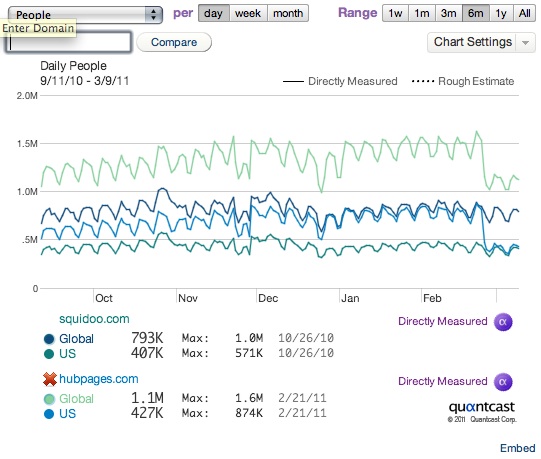
I just wanted to post a quick follow-up. I was actually checking to see if Squidoo traffic is down across the board, because I and a number of members have seen a very slight drop. But traffic drops every summer. But here’s Hubpages traffic vs. Squidoo traffic, measured directly via Quantcast:

The Feb 24 and Apr 11 Panda Updates are visible on Hubpages’ line. They’ve implemented a lot of changes, but it may take a while for Google to recrawl and reassess. The problem is (I believe) that part of Panda is a special algorithm that evaluates the quality of a domain/site, and from that derives a handicap which it applies to pages on the site. When someone asked how long before traffic came back after one totally re-tooled a site, Matt Cutts said the Panda algorithms have to be re-run. If I’m interpreting that correctly, it means that the site penalties are being updated less frequently the daily crawl to find/index content.

So Hubpages members need to stick tight a little longer and wait for Google to reassess what Hubpages has done to correct its problems. I’m hoping for their sakes (and mine; I’m trying to get a few irons in the fire over there) that they will have good news soon. Meanwhile, Squidoo members need to stick tight and see whether Squidoo has second-guessed itself in a wise or foolish way by implementing vast numbers of changes after successfully passing through Panda I and II unscathed. Most of them aren’t content-related, but some are navigation-related; in particular we’ve lost a vast number of internal links with lensroll getting phased out. And I’m uneasy about the extra line of adsense above the fold. We’ll see.

A quick survey of Panda news reveals nothing much, but M. Martinez has detected hints that Panda might unroll in Latin America next. To recap, Panda was implemented on U.S. Google results on Feb 24, all English-based Google results on Apr 11, and a minor Google update whose impacts I haven’t been able to see in the sites I’ve studied. I shall be interested to see what happens when Panda is implemented for French, Russian, and especially German Google.


My Lens on the Google Panda Update

Yes, you’ve probably already seen it: I’ve written a 3-page article discussing the Panda update’s impact on Squidoo and Hubpages traffic, and what lessons we can learn from it to stay ahead of the Google wrecking ball.

You may notice that the root message boils down to, “write unique content that your readers find USEFUL,” which isn’t exactly earth-shattering, but it’s amazing how many people try every approach but that one.

Unfortunately, if you publish on an open article-submission site like Squidoo or Hubpages, your content is partly judged by association, so you can get marked down by Google even if that’s exactly what you’re doing. Fight back by encouraging quality content on your favorite sites and leading by example.

I think Hubpages is taking some good steps to put its house back in order (as is Squidoo). We’ll see if Google agrees a few months from now.

Google Panda/Farmer Update Cont’d

I thought I’d check back in on Squidoo and Hubpages now that the Google Farmer Update (Panda update) has had some time to work. Short-term results can suggest major upheavals, but it’s the long-term stats that really mean something.

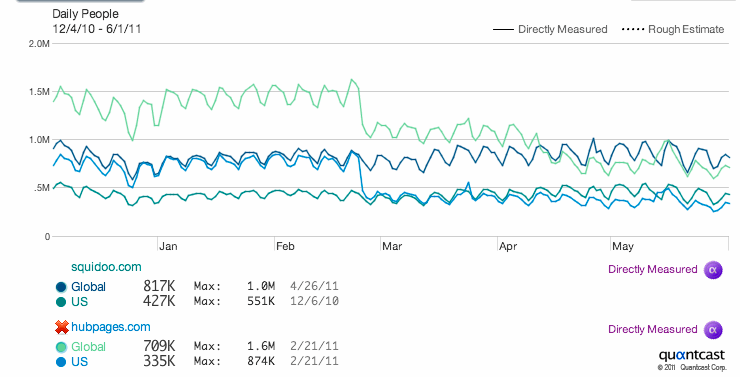
Here’s today’s traffic charts from Quantcast, showing that Hubpages traffic has stabilized:

Google Panda Update Impact on Hubpages and Squidoo

Keep in mind that the update was only for Google’s US search engine. It hasn’t yet been unleashed globally. The drop in U.S. users is included in “global” as well as “local” results.

My prediction, based on what I’m seeing, is that after this change, Hubpages’ traffic is going to be nearly the same as Squidoo’s. It already is within the US.

The Spam’s the Thing?

Jennifer Ledbetter of Potpiegirl.com made a mini study of specific spam phrases confirming by the numbers my guess in my last post on the Farmer Update: Squidoo’s ongoing spam crackdown means it has fewer (but alas, still some) pages on the most spammy topics than Hubpages and several other sites. This DOES explain why ehow.com didn’t lose places in the SERPs: it has even fewer pages matching these spam phrases.

Jennifer didn’t test this, but we both also argued — in different ways — that Hubpages’ much, much stricter policy on outbound links may be causing it some trouble. She pointed out that links on Hubs are nofollowed until you’ve reached a certain status. I related my experience of having all my hubs locked for having one link on each of them to cite the source of my photos. Squidoo’s got a nine outbound link per domain limit, instead, and it nofollows affiliate links in its merchant modules.

Various other ideas have been thrown out to explain the change. Another thing I pointed out is the significantly lower bounce rate of Squidoo compared to Hubpages, ezinearticles, and (of course) mahalo.

There’s just one problem.

The Quantcast traffic charts show Hubpages U.S. traffic simply dropped back to Squidoo’s levels.

If my explanations and Potpiegirl’s  guess about outbound links were correct, Squidoo should now be outperforming Hubpages. But it’s not. They’re now about the same.

Jennifer’s spam study shows that Squidoo has fewer pages than Hubpages on the spammy topics she chose to test, but not all that much less. The last phrase she checked (“tv for pc”) actually had more pages on Squidoo than Hubpages. (It really shouldn’t be filtered as spam; how to watch television on a PC is a reasonable query. It’s just gotten targeted by a lot of spammers trying to cash in on a popular search).

So my vote is on the spam being the deciding factor — as it should be — about how Google’s picking “quality” sites.  Let’s keep reporting and flagging it when we see it, folks, and for goodness’ sake don’t write on a Squiddont topic! Also, don’t give up on Hubpages. It’s gotten humbled, but it’s no worse off than Squidoo. And keeping eggs in different baskets is always a good practice.

The Google Farmer Update and Squidoo

Google Farmer Update: Early Returns

So, the manure has hit the rotary blades, and we’re starting to see some results from Google declaring war on so-called “Content Farms” in 2011. (When even mainstream news media hears about it, you know it’s big.)  Various pundits and industry experts had ideas on what content farms are, but until we saw the traffic shake-up, we couldn’t be sure how Google defined them.

Of course, I hear the little Michael Martinez devil’s advocate on my shoulder screaming “insufficient sample size, short-term data is inferior to long-term data”! but with that caveat, we’ve already got some apparent results.

Squidoo users, for the most part, haven’t seen any changes in traffic:

Squidoo Traffic Farmer Update


Hubpage users are feeling some pain (it’s all over their user forums), which is reflected in the Quantcast traffic data:

Hubpages Traffic Google Farmer Update


Go play with Quantcast to test your own favorites. Some aren’t available yet (ehow, ezinearticles), or are CLOAKED (mahalo.com, surprise surprise) so Quantcast can’t measure them.

For the big picture, see Danny Sullivan’s “Number Crunchers: Who Lost In Google’s “Farmer” Algorithm Change?” on SearchEngineLand, although Squidoo is too small a squid to have attracted detailed stat analysis by the experts, unfortunately.

My own traffic stats reflect what Quantcast saw: in fact, my traffic has been increasing slightly since the change (repeat: limited sample size) not dropping.

So what does this all mean for Squidoo users, most of whom publish on a variety of other platforms as well (including Hubpages)?

(more…)