Greekgeek's Online Odyssey - Hubpages and Online Article Writing Tips

Basic SEO

Which Backlinks Count for SEO?

This is  a huge question. Different tools find different backlinks. For example, checking my Free Web Graphics — How to Get Them (Legally!) lens on SquidUtils’ Backlink Checker, I get this:

This URL has 1000+ links from 6 domains.

  • angelfire.com 1
  • annbrundigestudio.com 20
  • digg.com 1
  • mythphile.com 25
  • squidu.com 952
  • squidutils.com 1

(Once again demonstrating the  limitations of social media for SEO, since the links from StumbleUpon, Del.ici.ous. Tagfoot and others don’t show up.)

1000+ backlinks is pretty good, right? Well, yeah, assuming (a) all search engines see the same backlinks as Yahoo Site Explorer (the database SquidUtils uses), and (b) all search engines count those links as relevant. But of course, they don’t.

(more…)

Add Tasty Bait to Search Engine Results!

People find things on the web by searching. SEO helps you get your page in front of people searching for it. SEO is like throwing fishing hooks into a sea full of hungry fish. The more SEO you know, the better you’ll be able to ensure your hook gets seen by lots of fish.

But a fishing hook isn’t enough to catch a fish. Even if you get to page one of search engine results, you still need your “hook” to stand out from all the rest. What kind of bait should you use to attract a click on your link?

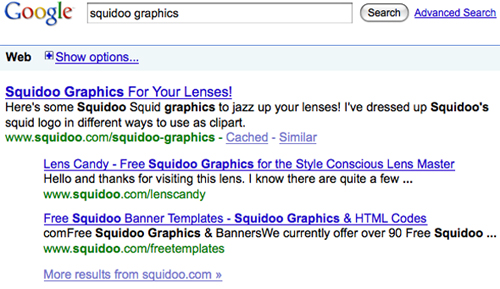
Look at this example:

search-engine-results

Something jumps out when you compare these search results.

(more…)

Using Squidoo’s Traffic Stats to Tweak SEO

Last time I talked about Squidoo Tags functioning as meta keywords. We know that meta keywords don’t boost SEO much, because most search engines, apart from Yahoo, don’t give them any more weight than any other link text on your lens.

So when you check your traffic stats tab on a lens, what good does it do to see which search phrases people used to get there? Newbie lensmasters often think they should add them as tags, but in fact, that may not be helpful.

Instead, I recommend using that data to apply SEO techniques manually. In this post, I’ll walk you through an example to show you how.

(more…)

Squidoo Tags and the Meta Keyword Tag: SEO or No?

Squidoo tags are funny beasts. They work in two entirely different ways: on Squidoo, as a way to cross-link lenses together, and in search engines, they help target search traffic. Just to be more complicated, we’ve got some conflicting info on how, exactly, search engines handle meta keywords, which for our purposes are Squidoo tags.

It’s time to sort out Squidoo tags and how to use ‘em.

(more…)

The “Antwerp Sound of Music” viral video and SEO

I  just made a new lens on a popular funny YouTube video, the “Antwerp Train Station Sound of Music” prank.

If you haven’t seen the video, you need to– it’ll make you smile. VERY effective. So far it’s gotten nearly 13 million hits, and that’s not counting all the duplicate copies floating around on YouTube plus a few million more on various European YouTube sites.

It’s a great case study in “linkbait,” content that’s so good people start linking to it. (Also known as “viral,” since linkbait this good can spread by word-of-mouth to millions of web users within days, even hours).

It also illustrates an SEO blunder.

(more…)

Internal Links — Overlooked, Powerful SEO Tip

A lot of people use linkbuilding as a major part of their search engine optimization strategy. They concentrate on getting links from other websites to point to their pages.

Did you know that internal links– links on the same website pointing to other pages on that website– can boost a page in search engine results? I haven’t found a study showing exactly how much of a boost they provide, but I am persuaded by those who have done their homework, done controlled studies, and observed the outcome to be convinced that internal links — links from page A to page B on the same site —  can boost page B’s position in search engine results.

(more…)

Which Social Media Sites Benefit SEO?

When a newbie asks how to build web traffic, one of the first pieces of advice they’ll hear is to submit their URL to StumbleUpon, Digg, Del.ici.ous, and other social media sites.

I got the same advice. I bought into it. But does social media/social networking really benefit SEO (search engine optimization)?

Hey, let me be social and ask you, the readers!

[poll id=”2″]

Now, let me give you my answer…

(more…)

Making Search Engine Results Look Sexy, Part II

In SEO Blunders: Very Un-sexy Search Results, I showed off my first Stupid SEO Trick! I’d decided not to worry too much about optimizing this blog, since I don’t want to shell out the money for a second webhost and domain name (a URL is the best spot for keyword optimization after page title).  However, I did at least want to optimize well enough that people searching for my blog by title would find it– all the more important since the domain name doesn’t match.

Unfortunately, I forgot one of my favorite tricks: make sure your keyword’s first appearance on your webpage is in a sentence that reads well when Google excerpts it in search results.

I took steps to correct the problem. To some extent, my corrections helped, but I still haven’t got it quite right. So here’s another quick lesson in how to shape your search engine results to make them look sexy– or at least what NOT to do.

(more…)

“My Lensrank or Traffic Is Dropping– Help!”

Hey, it happens to all of us. You wake up, check the dashboard, and– eek! Traffic on lens X is going down, and lens Y is now in a lower lensrank tier than it was yesterday. I want to throw a question out to my readers: what steps do YOU take, reflexively, to combat lensrank and traffic bleed?

I’m not talking about the best steps, in theory. I’m talking about what you do, for good or ill. And consider why you do them, and whether you know they work, or you’re just hopin’ or have “heard it works”, which a lot of us SEO journeymen do too often.

Confesssion time: here’s my “flail at traffic and lensrank” list. Some of these are good ideas, some of them “here’s hopin’.”

This is a tweaked version of a post I made at SquidU today answering the question.

(more…)

Two Quick Squidoo SEO Tips

I’m assuming most of you have read my Squidoo SEO tutorial, teaching you how to optimize your Squidoo page to help boost it to the front page of Google or other search engine searches.

Now, here’s two quick tips to help tweak the your SEO of existing Squidoo pages — and give it a lensrank boost to boot!

Keywords and Alt-Tags: Match ’Em Up

Check your traffic stats and see what keyword phrases are drawing traffic. (Hopefully, they match your chosen keywords.) Copy and paste them to a spare window.

Now go edit the lens and add alt-tags to all your images. That’s one of those chores we often neglect or put off. In naming images with alt-tags, keep your keywords in mind, especially those which keep turning up in searches.

If you don’t know what alt-tags are, read my section on How to Use Images to Drive Traffic to Your Lens!

Keywords: Plural Is Better Than Singular

Many search engines can find a singular from a plural (cat from cats), but not a plural from a singular. For some search engines, using the plural form is slightly better for optimization, as long as it’s not an irregular word like geese tht doesn’t have the word “goose” in it.

If you don’t know what a keyword is, get yourself back to my Squidoo SEO tutorial for a brush-up on search engine optimzation 101. It’s okay. There’s a lot of jargon out there; sorry I keep throwing it at ya!

Lensrank Boost?

Yep. Remember, regularly-updated Squidoo lenses receive a lensrank boost; if you leave a lens untouched for months, it drops. It’s usually better to scour the web for new quality content and link to it, and/or update your own content. But SEO  counts. After all, it’s bringing visitors.